The fastest fix is a seamless bodysuit or a matching slip in a shade close to your skin tone. For a durable, wear-it-forever answer, sew or glue in a lightweight lining. For a last-minute rescue on your way out the door, layer a slip with fashion tape over any gaping seams. Which one you reach for depends on the fabric, the cut, and whether you want that underlayer hidden or shown off as part of the look.
TL;DR:
- Matching the underlayer’s skin tone closely, rather than a generic nude, ensures invisibility under bright lights and camera flash.
- A seamless bodysuit is ideal for full-length sheerness or low-back styles, while slips suit midi and maxi hemlines for better breathability.
- Sewing a lightweight lining directly into the dress offers a durable solution for completely unlined sheer fabrics, with no-sew options working short-term.
- Wearing a visible, contrasting slip or lace bodysuit can turn the underlayer into a deliberate style statement for a more fashion-forward look.
- Testing the fix in daylight and with flash before leaving helps confirm it stays hidden or intentionally styled for the whole evening.
Table of Contents
- Undergarment options: bodysuits, slips, camisoles and briefs
- How to add a permanent lining, sewn or no-sew
- Blend in or show it off? Two valid styling routes
- Emergency fixes when you’re already running late
- Chiffon, tulle, or knit? Match the fix to the fabric
- Choosing colour and fabric weight without adding bulk
- Testing the fix and keeping it working
- What JV London checks before you buy underlayers online
- Why the standard advice oversells one fix
- Ready to build your see-through-proof wardrobe?
- Sources
- FAQ
Undergarment options: bodysuits, slips, camisoles and briefs
A seamless bodysuit is the default recommendation for a reason. It gives smooth, continuous coverage from shoulder to hip with no waistband to print through the fabric, which matters enormously on a chiffon or georgette dress where every seam shows. Bodysuits are widely flagged as the primary fix for dresses with thin straps or plunging necklines, precisely because there’s no extra hem or elastic edge to fight against.
Slips work differently and suit a different job. A full or half-slip cut to match your dress length keeps the silhouette clean under midi and maxi styles, and it breathes better than a bodysuit on a hot day. Camisoles and bandeaus are the minimal option: fine for a dress that’s only sheer around the bust or upper back, useless once the transparency runs the full length of the garment.
For the lower body specifically, high-waisted, mid-thigh shaping shorts smooth the midsection while covering everything a maxi or midi sheer skirt might reveal. Pair the shorts with a matching bandeau or bralette and you’ve solved top and bottom without the bulk of a full bodysuit.
- Seamless bodysuit — best for full-length sheer dresses, backless styles, low necklines.
- Slip or half-slip — best when you need breathability under midi/maxi hemlines.
- Camisole or bandeau — best for partial sheerness (bust or back panels only).
- High-waisted briefs or shorts — best for lower-body coverage under midi and maxi skirts.
Colour matters as much as cut. Choose a shade close to your own skin tone rather than a generic “nude,” and look for seam-free or laser-cut edges so nothing prints through under bright light.
Pro Tip: Buy your underlayer in a shade close to your actual skin tone, generally opting for a lighter shade works well. Most fabric slightly mutes colour once it’s under a layer of chiffon, so a shade that looks too pale on its own often reads correctly once the dress goes over it.
How to add a permanent lining, sewn or no-sew
Lining is worth doing when the sheerness is structural, not incidental. Illusion mesh panels built for support are one thing; a dress made entirely from unlined tulle, chiffon, or lace is another, and that’s where a permanent lining earns its keep.
- Check what you’re dealing with. Run a hand over the inside seams. If there’s no lining fabric attached at all, you’re working with true sheer and lining is the right call.
- Choose a lightweight lining fabric that matches the dress’s drape, not its weight. A stiff lining under soft chiffon will kill the movement that made you buy the dress in the first place.
- Measure and cut the lining slightly smaller than the outer fabric so it doesn’t peek below the hem.
- Pin along the existing seams, then machine stitch or hand-baste the lining into place. Sewing a lining into the seams gives the most durable, wash-safe result.
- For a no-sew alternative, apply a thin line of fabric glue or iron-on adhesive tape along the hem and side seams only, never across the whole panel. It holds for a few wears but won’t survive repeated washing the way stitching does.
- Take it to a tailor if the dress has curved seams, a fitted bodice, or fabric you’re not confident cutting into. A short, tailor-stitched panel keeps the dress’s original drape far better than a heavy full lining does.
Hand wash lined dresses where possible, and check any glued sections after each wear. Glue that’s starting to lift is a five-minute fix now and a ruined hem later.
Pro Tip: If you’re only self-conscious about one panel, don’t line the whole dress. A tailor can add a discreet inner panel just behind the sheer section for a fraction of the cost of relining the entire garment.
Blend in or show it off? Two valid styling routes
There isn’t one correct answer here. Fashion writers increasingly frame the underlayer as a genuine styling decision rather than a problem to hide, and both directions work depending on the event.
- Blend-in approach: tone-on-tone nude bodysuits or slips, seam-free finishes, nothing that draws the eye. This reads as polished and quietly done, ideal for daytime or work-adjacent events.
- Contrast approach: a visible slip in black or a bold colour, a lace bodysuit peeking through deliberately, a bralette used as a design feature rather than a cover-up. This turns the sheer panel into the point of the outfit.
- Outer layers — a blazer, an open cardigan, or even a denim jacket — let you dial the reveal up or down depending on the room. A belt cinched over the dress also breaks up transparency across the midsection.
- Neckline fixes matter separately from body coverage. Adhesive nipple cups handle a plunging neckline without the bulk of a full bra, and if the dress already has a built-in shelf bra, you may only need to solve the lower body.
Emergency fixes when you’re already running late
Sometimes there’s no time to sew anything. Here’s the order to work through:
- Double up. Slip plus camisole, or slip plus shorts, gets you instant opacity without shopping for anything new.
- Fashion tape the gaps. Run a strip along any seam edge or strap where the underlayer might shift and peek through during the evening. Tape and double-layering are the standard last-minute tactics for sheer garments, and they hold up well for a few hours of wear.
- Pin what doesn’t sit right. A safety pin tucked inside a seam can fix a slip that’s riding up or a hem that’s sitting unevenly under the dress.
- Iron-on hem tape solves a slip that’s slightly too long and showing below the dress hem, no needle required.
One caveat worth repeating: keep adhesives off beading, sequins, or delicate lace trim. Tape and glue can pull threads or lift embellishment when you peel them off, so test on an inconspicuous patch first.
Chiffon, tulle, or knit? Match the fix to the fabric
Not every sheer fabric behaves the same way, so the fix should follow the construction rather than a one-size-tackle-all instinct. Run your fingers over the inside of the dress and hold it up to a window before deciding.
Illusion mesh is the skin-toned, supportive netting used in a lot of formal and occasion wear. It’s often built with structure and even built-in cups already sewn in. Many gowns using illusion mesh already provide the coverage you need, so check before you buy a bodysuit you don’t actually need.
True sheer fabrics like unlined chiffon, georgette, and tulle have nothing hidden underneath, and they need a genuine solution rather than a quick patch. A seamless bodysuit works well under chiffon because both fabrics move together without pulling. Tulle behaves more like a structured net, so a sewn-in lining tends to outlast a bodysuit that can bunch under the stiffness.
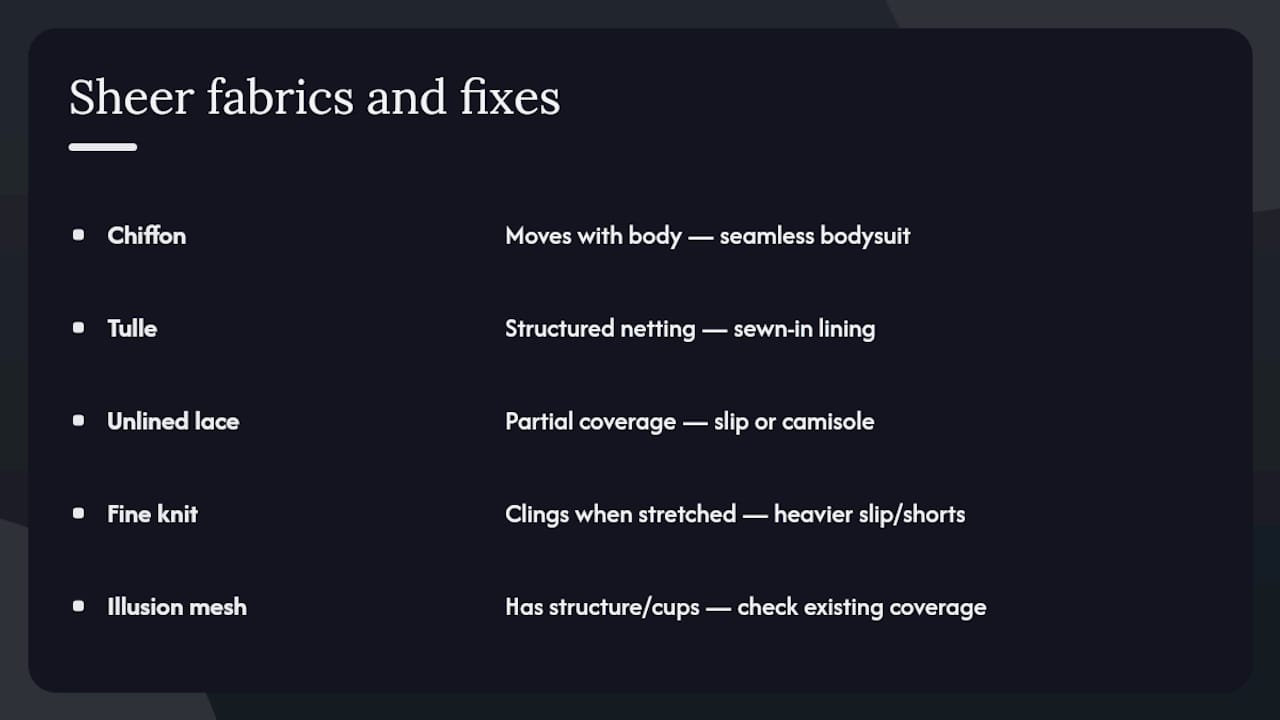
Unlined lace sits somewhere in between. The pattern itself creates partial coverage, so you often only need a slip or camisole underneath rather than a full lining, unless the lace has large open sections across the bust or midsection.
Fine knit sheers, the kind you find on some jersey wrap dresses, tend to cling. A slightly heavier-weight slip or shorts underneath stops the cling from becoming see-through under stretch, which is a different problem to a woven fabric going transparent under light.
Choosing colour and fabric weight without adding bulk
The wrong underlayer doesn’t just look off in photos, it changes how the whole dress sits. Two decisions matter more than any other: colour match and fabric weight.
On colour, match your underlayer to your own skin tone rather than the dress colour or a generic “nude” label that assumes one skin tone fits all. White underwear tends to flare under camera flash and shows more starkly against most fabrics than a tone-matched piece does, which is exactly the opposite of invisible.
On weight, thinner isn’t always better. A microfibre bodysuit that’s too flimsy can wrinkle under a fitted sheer dress and create visible lines, while a slightly firmer, compression-style fabric smooths rather than bunches. The rule of thumb: match a lightweight dress fabric (chiffon, georgette) with a smooth, low-profile underlayer, and reserve firmer shaping pieces for dresses with more structure, such as a fitted midi like the wrap midi dress with a waist tie, where a belt or tie already controls the silhouette.
Seams are the other bulk culprit. Look for laser-cut or bonded edges rather than stitched hems on slips and bodysuits, since a stitched hem is often the exact line that shows through a sheer skirt in direct sunlight.
Testing the fix and keeping it working
Do the check before you leave the house, not in the taxi. Three home tests catch almost everything: stand in front of a mirror in daylight, repeat it under a bright lamp, and take a photo with the camera flash on, since flash tends to expose exactly what ambient light hides.
- Walk and sit in the dress before you commit, since seams and slip edges often shift once you move rather than stand still.
- Check breathability, particularly with a bodysuit worn for a full evening, and swap for a slip if it feels restrictive.
- Recheck any glued or taped section after an hour of wear, not just when you put it on.
- Hand wash lined pieces where the care label allows, and remove no-sew adhesive gently with a fabric-safe adhesive remover rather than pulling at it.
- Book a tailor if a DIY lining starts puckering at the seams; a professional finish usually costs less than replacing the dress.
What JV London checks before you buy underlayers online
Buying a slip or bodysuit online carries less risk when returns are simple. JV London offers free UK shipping and 30-day returns, so a shade that doesn’t quite match isn’t a wasted purchase. Before ordering, check the fabric content, listed length against your dress, and seam finish on the product page. Cardigans and midi slips are useful complementary pieces worth having alongside your existing wardrobe.
Why the standard advice oversells one fix
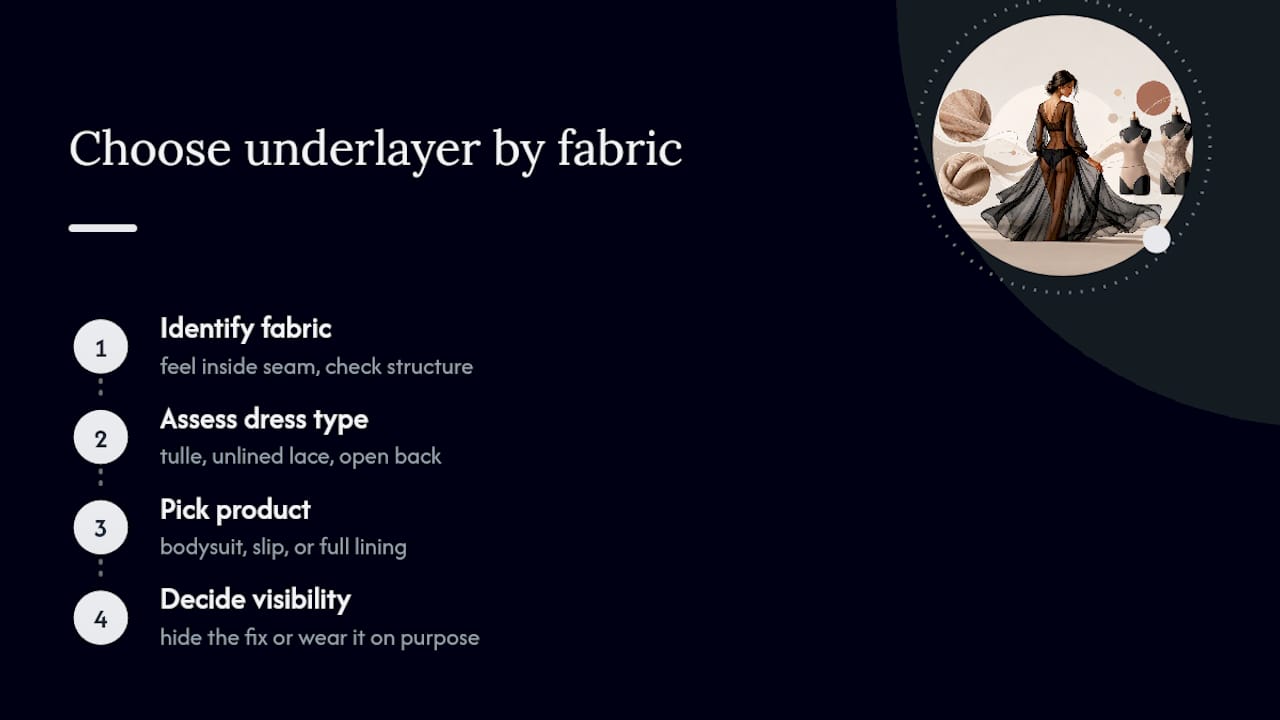
Most guides treat this as a single-answer problem: buy a nude bodysuit, done. That’s fine advice for a strapless slip dress, but it falls apart the moment you’re dealing with tulle, unlined lace with an open back, or a dress you actually want to wear a dozen more times. The honest answer is that fabric identification comes before product recommendation, not after. Feel the inside seam, check for existing structure, and only then decide between a bodysuit, a slip, or a proper lining.
What gets underrated is the styling decision itself. Treating the underlayer as invisible is one option, not the only correct one. A visible slip or a lace bodysuit worn on purpose often looks more considered than a poorly matched “nude” that’s slightly the wrong shade under flash photography. Prioritise getting the fabric read right first, then decide whether you’re hiding the fix or wearing it.
— Mykola
Ready to build your see-through-proof wardrobe?
JV London isn’t just a place to find dresses that need a fix, it’s a place to find the layering pieces and the outer layers that solve the problem in one order. The retailer offers shipping and returns policies that allow you to try a slip against a specific dress at home before deciding it’s right, with some risk mitigation if the shade or length isn’t quite there. Browse the belted midi dress with wide sleeves for a style that pairs naturally with a slip underneath, or check the cardigans collection for an outer layer that controls reveal on cooler evenings. If you already own the dress and just need the fix, start with a return-friendly slip or bodysuit order today and test it at home before your event.
Sources
- What to Wear Under a See-Through Dress: I Did All the Research — Glamour
- How to line sheer fabrics — Guthrie & Ghani
- What to wear with a sheer dress — The New York Times
- What to wear under a sheer dress — WhatWearUnder
FAQ
How Do I Make a See-Through Dress Work?
Identify the fabric first: true sheer needs a bodysuit, slip, or lining, while illusion mesh may already have built-in support. Match your underlayer to your skin tone and check opacity under a bright lamp or camera flash before you commit to the outfit.
How Do I Hide a See-Through Dress?
A seamless, skin-tone bodysuit or slip under the dress is the most reliable way to hide transparency without changing how the dress looks. Bodysuits work especially well under thin-strap or low-neckline styles because they leave no seam to show through the fabric.
How Can I Make a Sheer Dress Less Sheer Permanently?
Sew a lightweight lining into the dress’s existing seams for a durable result that survives washing, or use fabric glue along the hem and seams for a quicker, temporary version. A tailor can also add a discreet inner panel if you only need extra coverage in one area rather than throughout the dress.
What Should I Do if My White Dress Is See-Through?
Avoid plain white underwear underneath, since it tends to flash brighter under camera light and photography than a tone-matched piece. Choose a slip or bodysuit close to your own skin tone instead, and check the fix under both daylight and flash before wearing it out.