The most reliable default for tailored trousers is a slight or half break, measured with the shoes you actually intend to wear. A single soft fold at the front of the hem works across most builds, fabrics, and occasions. For contemporary casual looks, a quarter break or no break at all is the cleaner modern choice. Whichever you pick, rise, fabric weight, and wide-leg cuts can shift the right answer, so treat this as a starting point, not gospel.
TL;DR:
- The ideal trouser break depends on your shoes, with no break suits trainers and quarter or half breaks better for loafers and dress shoes.
- Measure inseam from crotch to hem with your usual shoes, but outseam from waistband to hem provides a more consistent length regardless of rise.
- Pants that pool or bunch around the ankle are too long, while riding up when walking indicates the inseam is too short or the rise is incorrect.
- For formal settings, a half break is safest because it remains balanced when sitting, while no break or quarter break suits casual or slim styles better.
- Always try trousers on with your actual shoes and sit down during fittings to ensure the length works in different positions.
Table of Contents
- What is a trouser break, and which style should you choose?
- How do you measure inseam and outseam correctly?
- How do shoes, rise, and fabric change the final hem?
- What should you tell your tailor at a fitting?
- Why do your trousers pool, bunch, or ride up?
- Classic half break or modern crop: which should you commit to?
- Sources
- FAQ
What is a trouser break, and which style should you choose?
The “break” is simply what happens where the hem meets your shoe: does the fabric fold, crease, or sit flat? It’s the single biggest factor in whether trousers look sharp or sloppy, and it’s decided entirely by length.
- No break (cropped): the hem sits above the shoe with no fold at all, showing a sliver of sock or ankle. This is the modern, fashion-forward option, common with loafers or trainers.
- Quarter or ankle break: a very slight touch of fabric against the shoe, barely creasing. It’s become the go-to for smart-casual and contemporary tailoring.
- Slight or half break: a single soft fold forms where the trouser meets the shoe. This is widely recommended as the most versatile, classic trouser length, and it’s the safest bet for interviews, weddings, or office wear.
- Full break: the fabric stacks in two or more folds, pooling slightly over the shoe. It reads as traditional, sometimes old-fashioned, and works best with relaxed, roomier cuts.
For formal or business settings, stick with a half break. It photographs well standing and holds up when you sit down, since movement during the day tends to raise the hem slightly, making a full break look heavier and a no-break look shorter than intended. Smart-casual outfits can flex towards quarter break, especially with loafers or Chelsea boots. Trainers almost always look better with no break or quarter break, since a fold over a trainer’s low profile tends to look accidental rather than deliberate.
Wide-leg and cropped trousers are the exception to all of this. A wide-leg pair needs to sit close to the floor at the back to keep its drape, even though the front edge sits higher, so the usual break rules bend to preserve the silhouette rather than match a specific fold style.
How do you measure inseam and outseam correctly?
Two methods work reliably. First, stand in the shoes you plan to wear most and measure from the crotch to the floor, or have someone measure straight down the inside of your leg. Second, and often more accurate, lay a pair of trousers that already fits well flat on the floor and measure from the crotch seam to the hem.
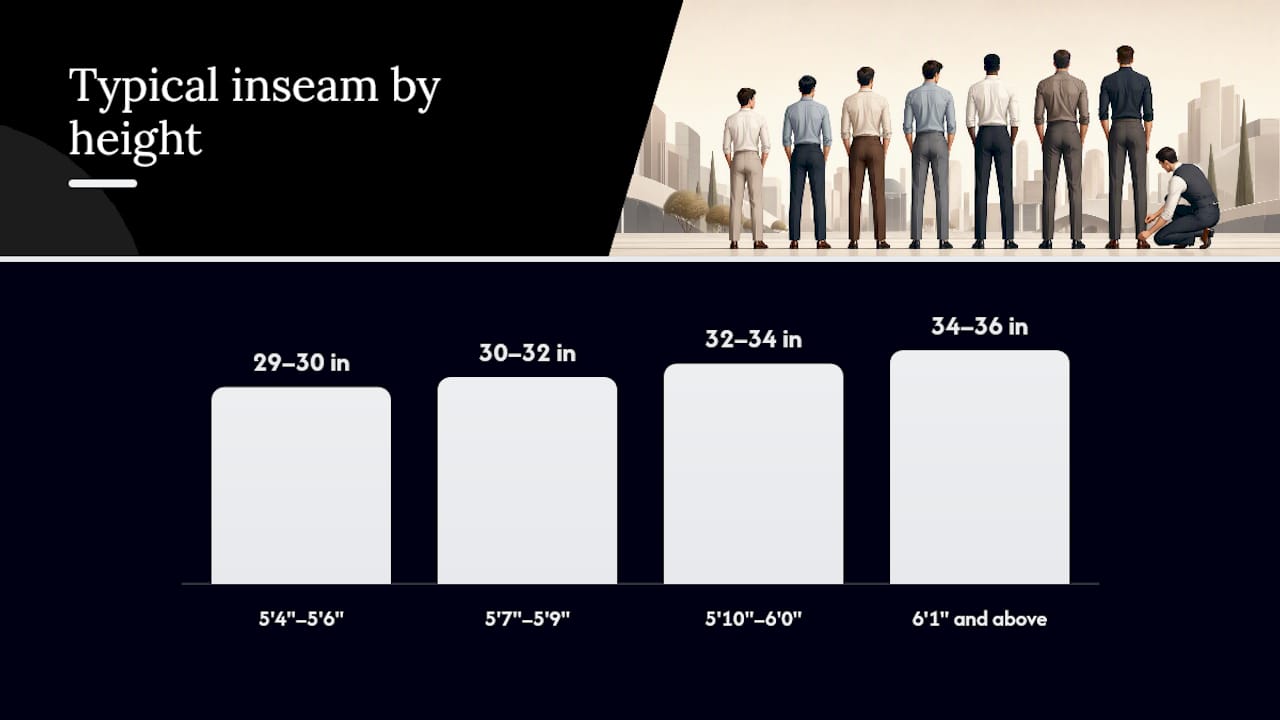
Inseam tells you the inside-leg length, but outseam (rise plus inseam, measured from waistband to hem) is the number to trust when comparing trousers with different rises. Outseam stays consistent for a given finished length regardless of how high or low the waistband sits, which makes it the more dependable figure when you’re switching between a low-rise chino and a high-rise tailored trouser.
Pro Tip: Keep a well-fitting pair as your reference trouser. Every time you buy new, lay it flat next to the new pair before cutting any tags off.
| Height | Typical starting inseam |
|---|---|
| 5’4" – 5’6" | a range starting around 29–30 inches |
| 5’7" – 5’9" | a longer range starting around 30–32 inches |
| 5’10" – 6’0" | an even longer range starting around 32–34 inches |
| 6’1" and above | roughly beginning at 34–36 inches |
This is a starting guideline, not a guarantee. Leg-to-torso proportion varies enormously between two men of identical height. UK retailers typically label lengths as Short, Regular, or Long, and Regular length usually targets a modal height band around 5’5" to 5’7", so if you sit outside that range off-the-rack sizing will rarely be spot on.
How do shoes, rise, and fabric change the final hem?
Your usual footwear does more to determine correct trouser length than most men realise. A chunky trainer sole adds height at the heel, effectively shortening the visible drop, while a slim dress shoe or Oxford sits lower and needs slightly more fabric to reach the same break.
- Loafers and dress shoes: low heel stack, so aim for your standard half-break measurement.
- Oxfords with a slight heel: similar to loafers, though a leather sole can add a few millimetres.
- Trainers: thicker soles often mean shortening the hem by half an inch versus dress shoes to avoid pooling.
- Boots: a higher shaft can visually shorten the leg, so many men size slightly longer to balance proportions.
Rise matters too. Moving from a mid-rise to a high-rise trouser typically shortens the required inseam by roughly 0.5 to 1 inch to land on the same break, since the waistband sits higher and the leg effectively starts further up.
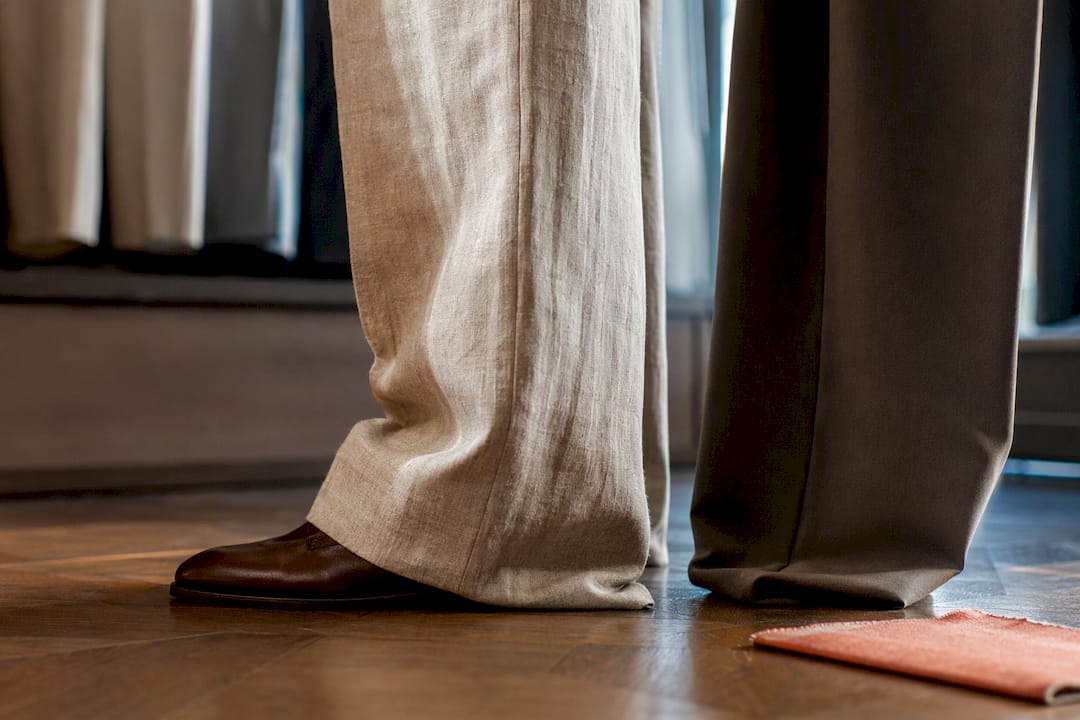
Fabric behaviour plays its part as well. Linen and lightweight cotton relax and crease through the day, which can make a precise half break look shorter by the afternoon. Heavier wool holds its line far longer. Wide-leg cuts are the outlier: they need close to floor-length at the back, generally an inch or two more than a straight-leg trouser at the same height, or the silhouette looks truncated rather than relaxed.
What should you tell your tailor at a fitting?
A good fitting is about more than pinning fabric. It’s about protecting your future options.
- Wear your actual shoes. Never get trousers hemmed in socks or the wrong footwear; the break will be wrong the moment you change shoes.
- Ask the tailor to preserve the original hem where possible. Cutting and discarding fabric removes any chance of lengthening later if your weight or style preference changes.
- Check how much can be let out. Most trousers have one to two inches of hidden fabric in the hem allowance; beyond that, you’re better off buying a longer length than forcing an alteration.
- Decide on cuffed versus plain. Cuffs (turn-ups) suit heavier fabrics and add visual weight to the leg; a 1.5 to 2 inch cuff depth is standard if you go that route.
- Sit down before you commit. Trousers that break perfectly standing can ride up noticeably once seated, so always do a sit-and-walk test with the tailor watching.
Why do your trousers pool, bunch, or ride up?
Fabric pooling at the ankle almost always means the hem is too long or you’re wearing lower shoes than when you last had them altered. Bunching around the knee or thigh, meanwhile, is a rise or seat issue, not a length one, and shortening the hem won’t fix it.
Trousers riding up when you sit or walk often point to an inseam that’s slightly too short combined with a low-rise cut. If you’re regularly showing sock at the ankle while standing still, that’s a length problem you can fix with a simple lengthening, provided fabric was left in the hem.
- Pooling or bunching at the ankle: hem is too long. Shorten it.
- Rides up, shows sock when seated: length or rise is too short. Try letting out the hem first.
- Looks fine standing, wrong when walking: likely a break that’s too aggressive. Move towards a quarter break.
- Persistent tightness anywhere above the knee: that’s a sizing issue, not a length one. Go back to the tailor rather than attempt DIY fixes.
Classic half break or modern crop: which should you commit to?
Tailoring purists will tell you the half break is timeless for a reason, and they’re not wrong. But the honest answer is that no-break and quarter-break styles have earned their place, particularly with trainers and slimmer cuts that were never designed with a fold in mind. The mistake isn’t choosing crop over classic. It’s switching between the two across your wardrobe so nothing looks deliberate.
Pick one approach and apply it consistently, then let your daily shoes decide the details rather than a rulebook. If you’re mostly in loafers and tailored trousers, a half break will serve you for years. If trainers dominate your week, build around no break and stop fighting it.
— Mykola
Sources
For deeper detail beyond this guide, Mr. Linen’s breakdown of trouser breaks covers the classic tailoring case in full. Bits & Bangles’ inseam chart explains outseam maths in more depth, and Dandylion Style’s measuring guide walks through both measuring methods step by step.
If you’re shopping for new trousers alongside sorting your length preferences, Jvwear’s trousers collection includes cuts like the striped elastic-waist style and the leopard print straight-leg trousers, both easy to hem to whichever break you settle on. The company offers shipping and returns policies that aim to accommodate fit issues after alterations.
- The inseam length chart: what numbers actually mean for your height – Bits & Bangles
- The Ideal Trouser Length: A classic guide to breaks in tailored trousers | Mr. Linen
- What is an inseam length and how to measure it perfectly – Dandylion Style
FAQ
Is a 32 leg length regular or long?
It depends on your height and the retailer, but a 32 inch inseam typically falls into the Long category for many UK brands, since Regular length is usually built around a shorter height band, roughly 5’5" to 5’7". Always check the specific retailer’s size chart, as labelling isn’t standardised across brands.
What length trousers should I wear if I’m 5’2"?
At 5’2", most starting points sit shorter than typical Regular sizing. Try the trousers on with your usual shoes and check for a slight or quarter break rather than relying on the label alone, since off-the-rack Regular lengths are cut for taller averages.
What trouser length do I need for my height?
There’s no single number, but a general chart helps: 29 to 30 inches for 5’4" to 5’6", 30 to 32 inches for 5’7" to 5’9", and 32 to 34 inches for 5’10" to 6’0". Measuring a well-fitting pair you already own gives a more accurate starting point than any height chart.
What does “Regular” length mean for trousers in the UK?
Regular typically refers to a middle inseam length, often around 30 inches, aimed at the most common height range sold by a given retailer. It’s a mass-market average rather than a precise fit, so anyone outside that typical proportion will usually need Short, Long, or a tailored adjustment instead.