Add 4 to a US women’s size to get the UK equivalent, subtract roughly 2 from a UK women’s shoe size to find the US one, and expect men’s numeric sizes to match almost exactly across both markets. Kids’ sizing is best matched by height in centimetres rather than age. None of these rules are guaranteed, though. Always check the brand’s own size chart and, where you can, measure yourself first.
TL;DR:
- UK women’s clothing sizes typically add 4 to US sizes, but brand inconsistency and vanity sizing mean measurements should be checked directly.
- Men’s clothing sizes generally match across UK and US markets, with chest, neck, and sleeve measurements converting directly, but fit can vary by brand and cut.
- Children’s sizes are more reliably matched by height in centimeters rather than age, with size up recommended if between brackets.
- Shoe sizes differ by about 2 sizes for women and less than one for men, and the specific fit depends on brand last shape and width.
- For accurate sizing, measure bust, waist, hips, and foot length personally, then compare to brand-specific size charts; avoid relying solely on label conversions.
Table of Contents
- UK vs US women’s clothing sizes: the +4 rule explained
- Do UK and US men’s clothing sizes match?
- How do children’s UK and US sizes compare?
- UK vs US shoe sizes: what’s the real difference?
- How do you measure yourself for accurate sizing?
- When do UK to US size conversions stop working?
- UK to US size conversion chart
- Plus size and extended sizing: where UK and US labels diverge most
- UK vs US hat and glove sizes
- UK vs US bra and underwear sizes: what actually converts
- Why do UK and US sizes differ in the first place?
- How UK vs US sizing confusion affects online shopping and returns
- Getting sizing right matters more than most shoppers realise
- How JV London helps you avoid the wrong size
- Sources
UK vs US women’s clothing sizes: the +4 rule explained
The standard conversion for women’s clothing is US size plus 4 equals UK size. A US 6 becomes a UK 10, and a US 8 becomes a UK 12, which lines up with the general pattern that UK sizing runs about two sizes smaller than US sizing for womenswear. It’s a genuinely useful shortcut, but it’s also the rule shoppers get burned by most often, because brands apply it inconsistently.
Here’s roughly what those sizes mean on the body:
- UK 8 / US 4: approximate bust, waist, and hip measurements
- UK 12 / US 8: approximate bust, waist, and hip measurements
- UK 16 / US 12: approximate bust, waist, and hip measurements
Two things break this rule constantly. First, vanity sizing means American labels have crept smaller over the decades, so an “8” today fits looser than an “8” from 1995. Second, European brands sold in the UK often label garments with EU sizes (38, 40, 42) instead of UK numbers, which throws the +4 formula out entirely unless you convert EU to UK first.
Pro Tip: Check the “model wears” note on a product page. If a 5ft 9in model with a 34in bust wears the size medium, that tells you far more than the label itself.
Do UK and US men’s clothing sizes match?
Men’s sizing is the one area where the UK and US genuinely agree most of the time. A UK 40 jacket and a US 40 jacket are cut to the same chest measurement, and shirt sizing follows the same pattern, since men’s numeric and letter sizes stay largely consistent between the two markets.
- Chest size is the number that matters. A UK/US 42 jacket fits a 42in chest in both markets.
- Neck and sleeve labels (like 16/34) on formal shirts convert directly, no maths required.
- Trouser W/L labels are identical everywhere. A W32 L32 pair measures the same waist and leg length whether it’s stocked in London or Los Angeles.
The exception worth knowing: some American casualwear brands run slightly generous through the shoulders and torso compared with British cuts, so a snug UK fit might feel roomier in a US-designed piece.
How do children’s UK and US sizes compare?
Both markets label kids’ clothing by age, but children of the same age vary enormously in height, so age is the least reliable number on the tag. Height in centimetres gives a far more accurate match between UK and US labels than age alone.
A rough mapping looks like this:
- 2-3 years: height 92-98cm, roughly UK size 2-3, US size 2T-3T
- 4-5 years: height 104-110cm, roughly UK size 4-5, US size 4-5
- 7-8 years: height 122-128cm, roughly UK size 7-8, US size 7-8
Notice the US uses “T” (toddler) sizing up to around age 4, which doesn’t exist as a concept in UK labelling.
- If your child sits between two height brackets, size up rather than down.
- Growth room matters more for coats and trousers than for T-shirts.
- Check sleeve and inside-leg length separately if the child is tall for their age.
UK vs US shoe sizes: what’s the real difference?
Women’s shoes convert differently to women’s clothing. The general rule is UK size = US size minus 2, so a UK 5 is roughly a US 7 to 7.5, matching the pattern that shoe conversions commonly differ by about 2 to 2.5 sizes between the two markets. Men’s shoes shift by a smaller margin: subtract roughly 0.5 from a US men’s size to land on the UK equivalent, so a US 9 sits close to a UK 8.5.
The number that trips people up: UK shoe sizing is typically unisex, while US charts split into separate men’s and women’s scales entirely. That means a “UK 6” on a women’s shoe and a “UK 6” on a men’s shoe aren’t automatically the same length, which is exactly the kind of detail that gets lost when you’re converting labels rather than measuring feet.
- Width matters as much as length. A shoe cut on a narrow last will feel tight even at the “right” size.
- Brands vary the last shape enormously, so a size that fits perfectly in one label can pinch in another.
- When two sizes seem borderline, read the brand’s own fit notes before ordering, and size up if the shoe runs narrow.
How do you measure yourself for accurate sizing?
Measurements beat labels every time, and a measurement-based converter will get you a far more reliable match than converting a label number on its own. Here’s how to take the numbers that matter:
-
Bust/chest: wrap the tape around the fullest part, keeping it level and snug but not tight.
-
Waist: measure around your natural waistline, usually just above the belly button.
-
Hips: measure around the widest part of your hips and seat.
-
Inseam: measure from the top of your inner thigh to your ankle bone for trouser length.
-
Foot length: stand on a sheet of paper, mark your heel and longest toe, then measure the distance in centimetres.
Once you’ve got these figures, hold them against the brand’s own size table rather than relying on the label conversion. If you land between two sizes, size up for stretch fabrics and structured pieces you want a looser fit in, and size down for jersey or anything with generous stretch. Our guide to matching bust, waist and hip measurements walks through this in more detail.
Pro Tip: Keep your measurements saved in your phone’s notes app. Half the guesswork in repeat online shopping disappears once you’re not remeasuring every time.
When do UK to US size conversions stop working?
European sizing complicates things further, since EU 36 is roughly a UK 8, EU 38 a UK 10, and EU 40 a UK 12, but the jump between each EU size can feel bigger or smaller depending on the brand’s home market. Spot vanity sizing by checking whether a brand’s small-size measurements feel generous compared with the size chart’s own numbers, which is common with US-based labels chasing a flattering fit perception.
Before buying, run through this quick checklist on any product page:
- Does the listing give model measurements alongside the size worn?
- Are the size table units in centimetres, inches, or both?
- Do customer reviews mention running large, small, or true to size?
If any of those three are missing, treat the label as a rough guide rather than a guarantee, and consider common online sizing errors before you commit.
UK to US size conversion chart
| UK size | US size |
|---|---|
| 8 | 4 |
| 10 | 6 |
| 12 | 8 |
| 14 | 10 |
| 16 | 12 |
| UK men’s shoe | US men’s shoe | UK women’s shoe | US women’s shoe |
|---|---|---|---|
| 7 | 7.5 | 4 | 6 |
| 8 | 8.5 | 5 | 7 to 7.5 |
| 9 | 9 | 6 | 8 to 8.5 |
| 10 | 10 | 7 | 9 to 9 |
Treat these tables as a starting point, not a promise, since fit still varies by brand, cut and fabric even when the numbers line up on paper.
Plus size and extended sizing: where UK and US labels diverge most
The +4 rule gets shakier the further up the size range you go, and plus size is where it breaks down most visibly. A UK 20 doesn’t reliably map to a US 16 the way the standard formula suggests, because extended size ranges are often graded separately from a brand’s core collection, sometimes by a different design team entirely, with different assumptions about where the body carries volume.
US plus sizing frequently splits into two parallel systems: numeric extended sizes (16, 18, 20, 22) and a separate “W” designation (14W, 16W, 18W) that doesn’t share a clean line with UK numbering. A US 16W and a US 16 (non-W) are not the same measurements, which means shoppers converting from a UK size need to check which US system a retailer is actually using before applying any formula.
Grading also changes shape, not just size, at the top of the range. A UK 22 dress isn’t simply a UK 14 scaled up proportionally. Cut, ease and even sleeve width get adjusted, so brands that grade plus sizes properly will publish separate measurement charts for their extended range rather than extrapolating from their core sizes. If a retailer doesn’t offer that, treat it as a warning sign.
The practical fix is the same one that runs through this entire guide: measure your bust, waist and hip, then check them against the specific chart for the size range you’re buying in, plus size included. Never assume the standard conversion holds simply because it worked for a mid-range size lower down the chart.
UK vs US hat and glove sizes
Hats and gloves use their own conversion logic, and it’s less forgiving than clothing because these are rigid-fit accessories. UK hat sizes are traditionally given in inches, measured around the head just above the ears, so a UK size 7 hat corresponds to a 22-inch head circumference. US hat sizing increasingly uses the same inch-based measurement directly, or small/medium/large bands, which means the safest approach is to measure your own head circumference in centimetres or inches and match it to the brand’s stated measurement rather than assuming a size 7 UK hat equals a specific US letter size.
Gloves follow a similar logic but measured differently: glove size is based on hand circumference around the widest part of the palm (excluding the thumb), given as a number that roughly corresponds to inches. A UK/US glove size 8 typically means an 8-inch palm circumference in both markets, since glove sizing is one of the few categories where the UK and US genuinely converge on the same measurement basis. The variation comes down to brand and glove type rather than country, with fitted leather gloves running tighter than knitted or fleece-lined ones at the same labelled size.
If you’re buying either category online, look for the circumference measurement in the product description before trusting the letter or number size alone.
UK vs US bra and underwear sizes: what actually converts
Underwear is one of the few categories where the UK and US agree on the fundamentals. Bra band sizes are identical between the two markets, so a 32, 34 or 36 band means the same rib cage measurement whether the label says UK or US. Cup letters also align up to a DD cup.
Beyond DD, the systems diverge and this is where most fit complaints start. UK cup sizing continues in a straightforward alphabetical sequence (E, F, FF, G, GG, H), while US brands sometimes double letters differently or introduce DDD/E as an alternative to the UK’s own DD/E split. A UK G cup and a US G cup are not always cut the same, so anyone above a DD should measure band and bust separately and check the specific brand’s cup conversion chart rather than assuming the letter transfers across.
Knickers and briefs follow the general women’s clothing conversion, meaning the same +4 rule and the same caveats about brand variance apply. Sizing here tends to be more forgiving than structured garments, given the stretch most everyday underwear fabrics allow, but shapewear and structured styles behave more like outerwear: measure first, and don’t assume a size that fits in cotton briefs will fit identically in a firmer-control style.
Why do UK and US sizes differ in the first place?
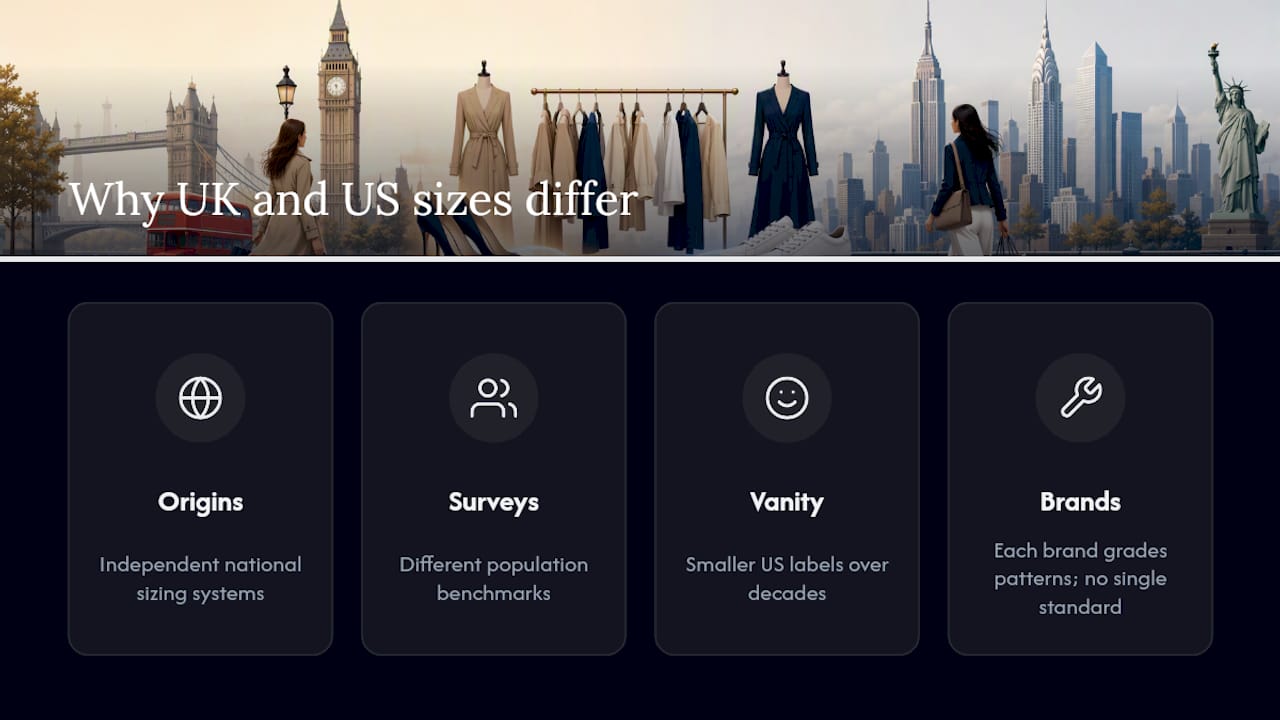
The split traces back to how each country built its sizing standards independently, at different points, using different reference populations. UK sizing has roots in British Standards work carried out through national surveys of the population’s body measurements, aimed at giving manufacturers a shared reference for mass production. American sizing developed along a parallel but separate track, shaped by US government-backed anthropometric surveys of American women’s and men’s bodies conducted across the twentieth century, which naturally produced different benchmark measurements given a different population.
Once these separate systems existed, they never fully reconciled, even as international trade in ready-to-wear clothing expanded. Retailers had commercial reasons to keep their own scales too: vanity sizing crept into American labelling over the decades partly because smaller labelled numbers had a flattering effect that helped move stock, gradually widening the real measurements attached to any given US size compared with its UK counterpart.
Add to that the fact that clothing brands, unlike shoes or hats, have never been forced into a single mandatory international standard the way some other consumer goods have. Each brand still grades its own patterns, which is precisely why a formula like “US plus 4” is a useful average rather than a fixed law. The historical mismatch between two population surveys, decades apart, is baked permanently into every size label you see today.
How UK vs US sizing confusion affects online shopping and returns
Sizing mismatches are one of the biggest drivers of returns in international online shopping, and the UK to US gap is a frequent cause when British shoppers order from American retailers or vice versa. A shopper who trusts the label rather than checking measurements risks ordering a size that looks correct on paper but fits nothing like expected once it arrives, particularly with the plus size and cup-letter divergences already covered.
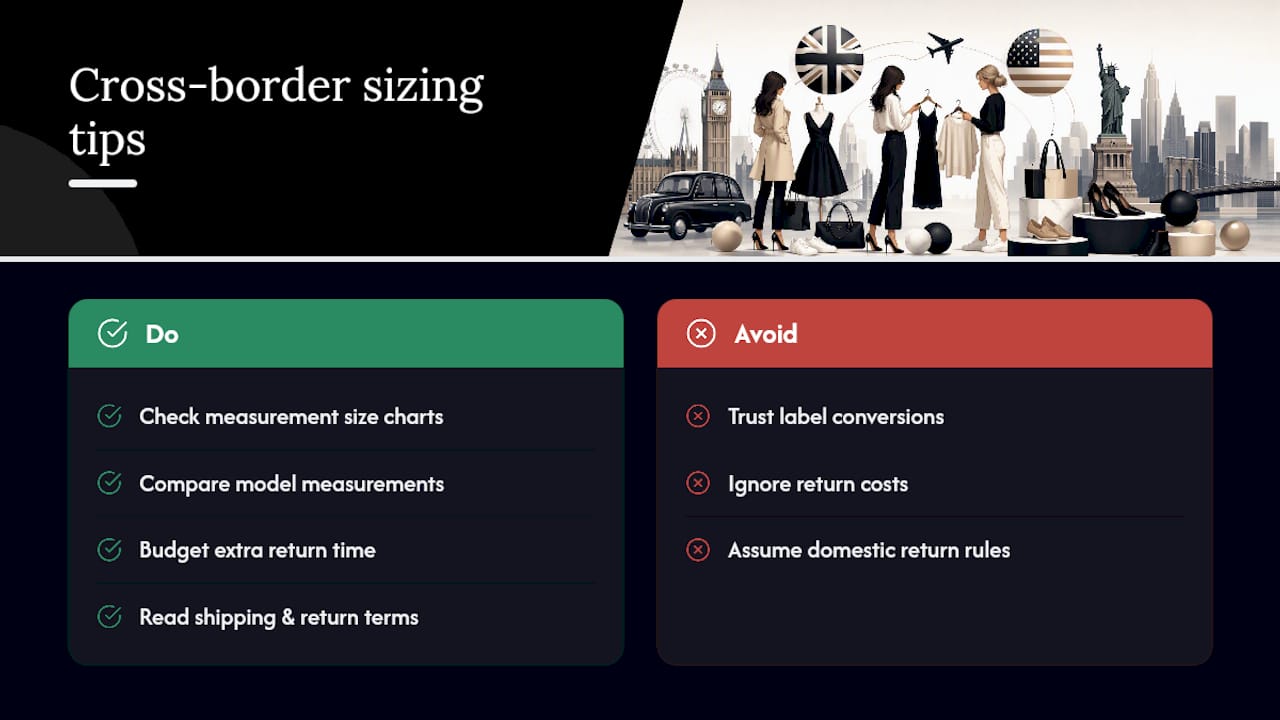
International shipping adds another layer of friction on top of the sizing risk itself. A return that crosses a border typically takes longer, sometimes carries a cost the shopper wasn’t expecting, and can involve customs paperwork that a domestic return never touches. That combination, wrong size plus a slow or costly return, is exactly why measurement-first shopping matters more when you’re buying across the UK/US divide than when you’re shopping within a single market’s sizing system.
Retailers that publish clear, measurement-based size charts alongside model measurements reduce this problem significantly, because the shopper isn’t relying on a converted label number at all. The size charts and return terms on any UK retailer’s own site are also generally easier to act on than a US retailer’s, simply because the UK shipping, sizing and consumer return norms are the ones familiar to a UK shopper. If you’re ordering from a US-based site, budget extra time for the return process and read the shipping terms before you buy, not after the parcel arrives.
Getting sizing right matters more than most shoppers realise
The mistake I see most often isn’t ignorance of the conversion rules. It’s overtrusting them. Shoppers apply “+4” or “minus 2” like a fixed law rather than a rough average, then blame the brand when the fit doesn’t match. Good retailers close that gap with clear charts, honest model measurements and returns that don’t punish you for guessing wrong.
— Mykola
How JV London helps you avoid the wrong size
This retailer offers an alternative to guessing your way through a US label conversion. Product pages carry specific size charts with measurements in centimetres and inches, plus model measurements, so you can match your body against real numbers rather than relying on label conversions.
Shopping in the UK means UK shipping norms apply. Orders typically include options for free UK shipping, and there is usually a 30-day period for hassle-free returns. That takes the pressure off getting the conversion perfect on the first try. Browse pieces like the Eden casual summer dress or the Solvra two-piece midi dress set, check the size chart against your own measurements, and order knowing a size mismatch isn’t the end of the story. If you’re still unsure between two sizes, read our guide on returning online dresses in the UK before you check out, then buy with confidence.
Sources
- US to UK Clothing Size Conversion Chart (Men, Women, Kids)
- Clothing Size Converter (US ↔ UK ↔ EU) | Free Size Calculator by Measurements
- Tellar
- Comparing UK Size Vs. US Size for Clothes | Kiwi Sizing